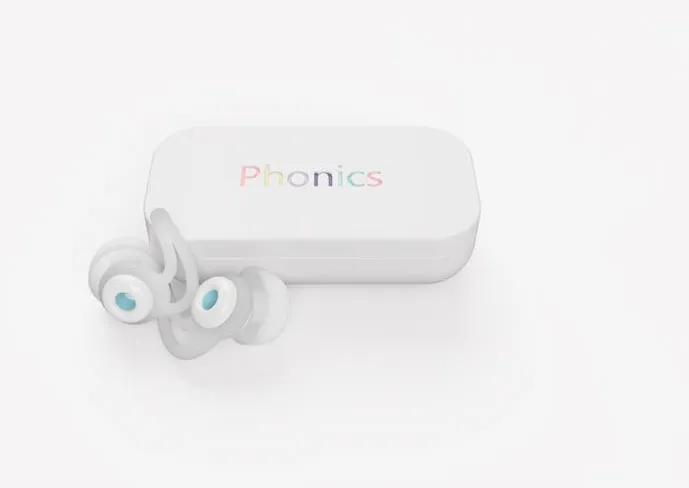
A discreet in-ear device which attenuates triggering sounds for children with auditory hypersensitivity.
At a glance
Role
Product design student, one of a team of four
Team
Group of four: Calum McCarthy, Tadhg Morrisroe, Sam Grogan and Salome Riva
Timeline
Final year of my BSc Product Design (2021–2022)
Status
College project, BSc Product Design at TU Dublin
What it shows
Secondary and primary research
Interviews and insight statements
A persona and a journey map
Concept sketching, human factors and ergonomics
A 3D-printed prototype tried by a test user
Highlights
Top 50of 1,000 applicants in the Enterprise Ireland Student Enterprise competition
Highly Commendedin Design at the Bolton Trust Awards
Discover
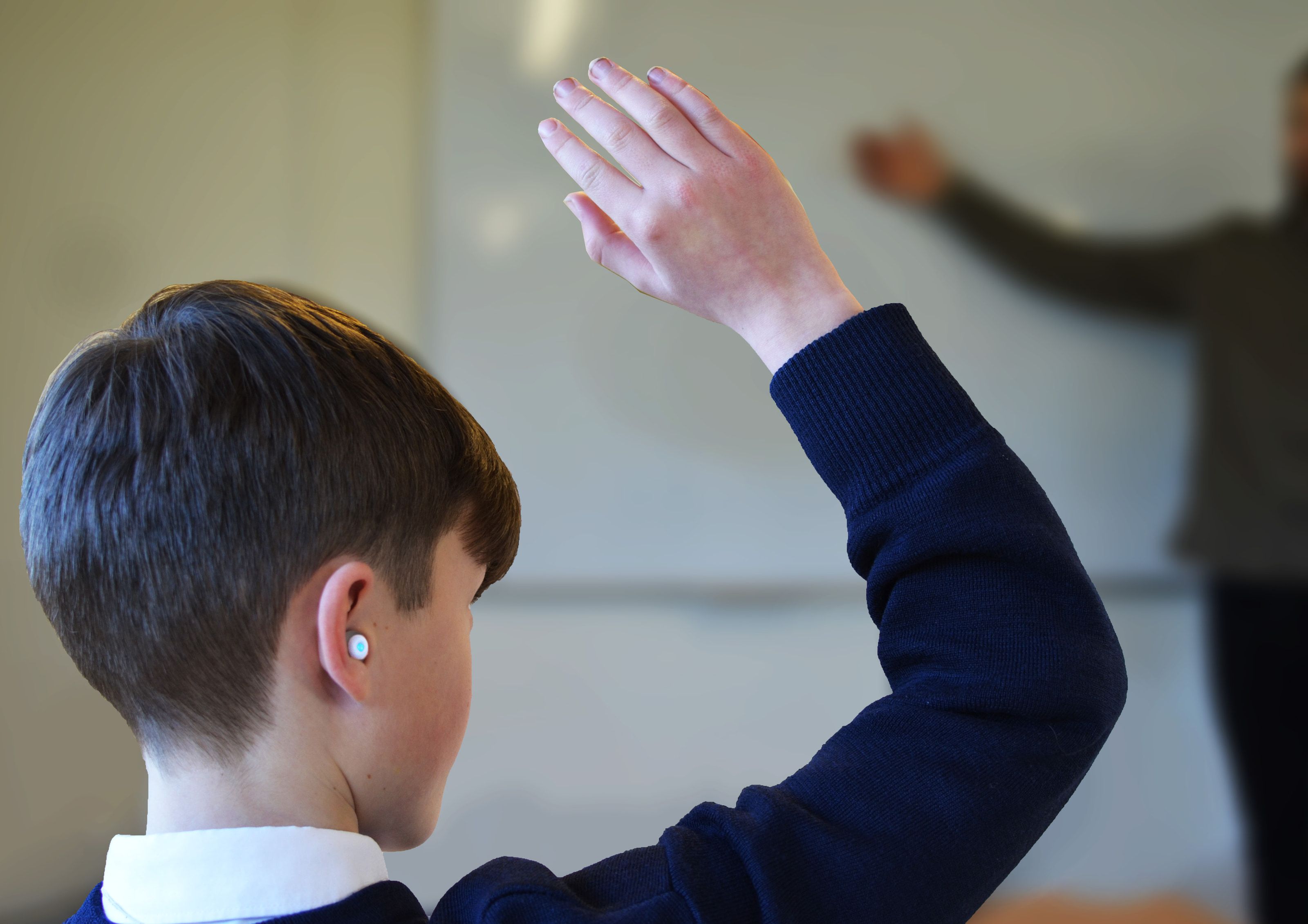
Phonics is an earpiece that helps autistic children suffering from auditory hypersensitivity. It reduces sound triggers by tuning out triggering noises of varying frequencies without interrupting their learning quality in the classroom or affecting low-volume conversational noise, like the teacher’s voice.
A contact who works with children with special needs made us aware of the daily problems they face with sensory overloads.
02
Step 02
Secondary research
Special educational needs in Ireland, and how sensory overloads affect children at school.
03
Step 03
Interviews
A parent, a Special Education Needs Officer and a teacher (the last two by teammates).
04
Step 04
Insight statements, a persona and a journey map
Simon, a 10-year-old in a mainstream primary school, and two hours of his school day.
05
Step 05
User needs
Sensory equipment that doesn’t alienate them, a way to communicate what is bothering them, more sensory equipment in school, and control over sensory overloads.
This research area was chosen as it is a topic that is overlooked in many ways:
Many people see sensory outbursts as misbehaviour.
It affects the educational quality for a large proportion of children.
Children can feel ostracised or isolated.
This decision came about due to a contact who works with children with special needs and had made us aware of the daily problems they face.
Special needs assistance
Special Educational Needs (SEN) is defined as any “restriction in the capacity of a person to participate in or benefit from education.” Special needs assistance aims to help a child with special educational needs; this includes sensory rooms, ear mufflers, and sensory equipment like weighted blankets and stress balls.
1 in 4children in Ireland have a form of special educational need: approximately 250,000 affected daily
71%of these 250,000 attend mainstream schools, with access to fewer resources than at a special school
140+special needs schools across Ireland
1.5 hrschildren are recommended to take movement breaks every hour and a half, to prevent sensory overload
€1.9bnover one fifth of the government’s education budget, spent on special educational needs in 2020, and only expected to increase
This means:
A large sector with lots of space for innovation.
Sensory needs have been overlooked in mainstream schools.
Education in the classrooms has been affected. Teachers must tend to children experiencing sensory overload, and the child’s involvement in class is hindered due to uncomfortable feelings of overload.
A good possibility for investment.
Sensory disorders
A sensory overload occurs when there is an overstimulation of one or more of the body’s five senses. This can affect anyone, but it is very common in people with Autism Spectrum Disorder (ASD).
Daily experiences like going to school or offices can lead to a sensory overload.
It is different for everyone: some people may be more sensitive to sound, others may be more sensitive to noise.
Symptoms can include the inability to ignore loud sounds, strong smells and other types of sensory inputs, a feeling of discomfort, anxiety and fear, extreme sensitivity to clothing or other textures, feeling overwhelmed or agitated, irritability, loss of focus, restlessness, and stress.
Children may cry, cover their face or ears, and close their eyes to show their discomfort.
The symptoms can often be mistaken for “bad behaviour”, because they can cause children to run away from situations, throw tantrums, or appear irritable and restless.
Like I’m no longer in sync with what is happening around me. It feels like the rest of the world is moving at a pace I can’t hold on to and have to let go. Then I feel like I want to escape to a safe and quiet place to calm down and relax a bit.
Quoted in the Phonics secondary research
In order to help with this, it is important to help the child understand what is bothering them. This way they can prepare themselves, and hopefully find a solution for when they experience these feelings again.
Define
Interviews
P
Paul
Parent
Pain points
Family misses out on experiences due to risk of triggers.
Key insight
Ear mufflers are not effective, as they are uncomfortable and ugly. Movement can be an effective solution to sensory overloads.
Opportunity
A comfortable device that cuts out sound triggers while the child is engaged in activity.
J
Julia
Special Education Needs Officer
Pain points
Students embarrassed using sensory equipment
Minimal sensory funding
Key insight
Students often block sound with music. Each child has different sensory requirements. Sometimes need to leave the room.
Opportunity
A way for students not to miss out on class time. Discreet sensory equipment for children.
Interview by a teammate
M
Mary
Teacher
Pain points
Sound is a common trigger
Hard to communicate during overload
Key insight
Avoids ear mufflers as she notices kids cannot hear anything and therefore struggle with their school experience.
Opportunity
Ear mufflers that don’t hinder the child’s educational experience.
Interview by a teammate
Insight statements
ContextDilemmaWhyMotivationIdealInsight
Context
Students suffering from sensory overloads often need to relax in quiet areas when overwhelmed.
Dilemma
Lack of resources in mainstream secondary and primary schools for sensory equipment and sensory rooms.
Why
There is no official way to install a sensory room. Schools also often put funding into other areas.
Motivation
Treating sensory overloads in the correct way is healthier in the long run for those experiencing it.
Ideal
All that suffer from sensory overloads in school have easy access to a sensory room designed to calm them.
Insight
There is no suitable equipment in class to help manage sensory issues, and this hinders the child’s ability to be involved in class (they feel alienated).
Context
Teachers often mistreat and misunderstand children with sensory issues.
Dilemma
Parents’ relationships with their children are damaged at younger ages as teachers report poor behaviour.
Why
Constant negativity around kids’ school experience means all parties are stressed and uneasy.
Motivation
A healthy relationship for parents and child leads to a healthier life for the child, as parents can focus on sensory issues.
Ideal
Teachers and parents are given the means to understand and cope with children with sensory disorders daily.
Insight
Constant negative feedback from teachers puts a strain on the parent–child relationship.
Meet Simon
Simon is our persona. Simon is a 10-year-old boy in 4th class in a mainstream primary school in south Dublin. Simon suffers from ASD and sensory disorders. He finds school difficult as it is an alien environment for him, and he finds school stressful and overloading. He is often singled out because of issues he can’t control. His parents love and support him, but are disheartened by the school’s continual complaints about his behaviour when he acts fine at home.
Task goalsEnsure good quality of education by ensuring Simon can participate in class. Improve the student–teacher relationship, preventing the teacher feeling the need to make complaints to Simon’s parents.
Pain pointsLoud, unpredictable noises in the school environment can cause Simon to feel overloaded and unable to calmly participate in class. Some current solutions single Simon out and make him stand out; this alienates Simon from the class.
Experience goalsEnsuring Simon can seamlessly participate in class and feel more comfortable and relaxed in school.
Key behavioursLoud, unpredictable noises can cause Simon to feel overwhelmed and shut down, stopping communication and not wanting to participate in the class. Some of Simon’s coping mechanisms for preventing a sensory overload seem strange to the teacher and class, and make him stand out.
Journey map
This journey map follows Simon over an average two-hour period in a school day, documenting his emotions throughout this period. It starts with the class working quietly on their own, before they transition to an interactive lesson among the class.
1
Working quietly. During this period the class are working quietly at their own work. Simon is in a calm environment and is getting the most out of this educational experience.
2
A new lesson starts (low point). As the class moves to a new lesson, some children begin to stand and move about, and a chair is pulled out from a desk and scrapes the floor.
3
Working quietly again. During this period the class are working quietly at their own work. Simon is in a calm environment and is getting the most out of this educational experience.
Journey map over a two-hour period of a school day, following Simon.Curve traced from the Phonics process book, page 10.
User needs
Sensory equipment that doesn’t alienate them from their peers
Earplugs are more comfortable than over-ear ear mufflers, due to the pressure and sweat the ear mufflers cause. They just don’t do as good a job at noise cancellation.
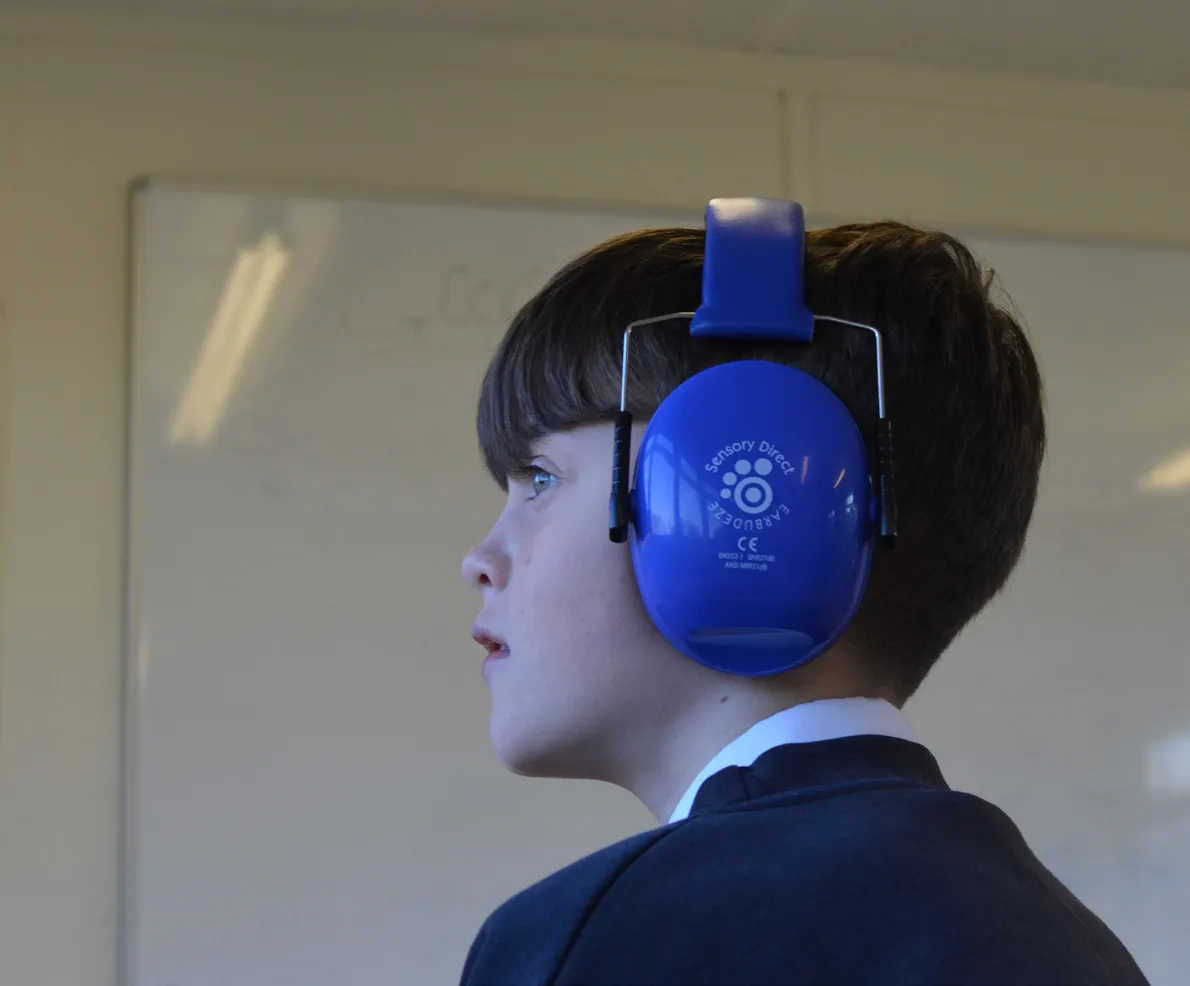
Ear mufflers block out all sound, so it can be quite hard to hear when engaging in conversations or listening to the teacher.
Active noise-cancelling devices put added pressure on his head, and they trigger other sensory issues.
Current earplugs are too big and fall out of his ear.
Over-ear devices make him feel anxious and claustrophobic.
Simon would like:
A product he could still use when with other people, and that he doesn’t have to take out when engaging in a conversation.
A product he could wear comfortably for a longer period of time.
A more effective, discreet earplug.
A lightweight product that didn’t trigger other sensory issues.
Design a discreet in-ear device which attenuates triggering sounds for children with auditory hypersensitivity.
The redefined brief
Design
Concept development
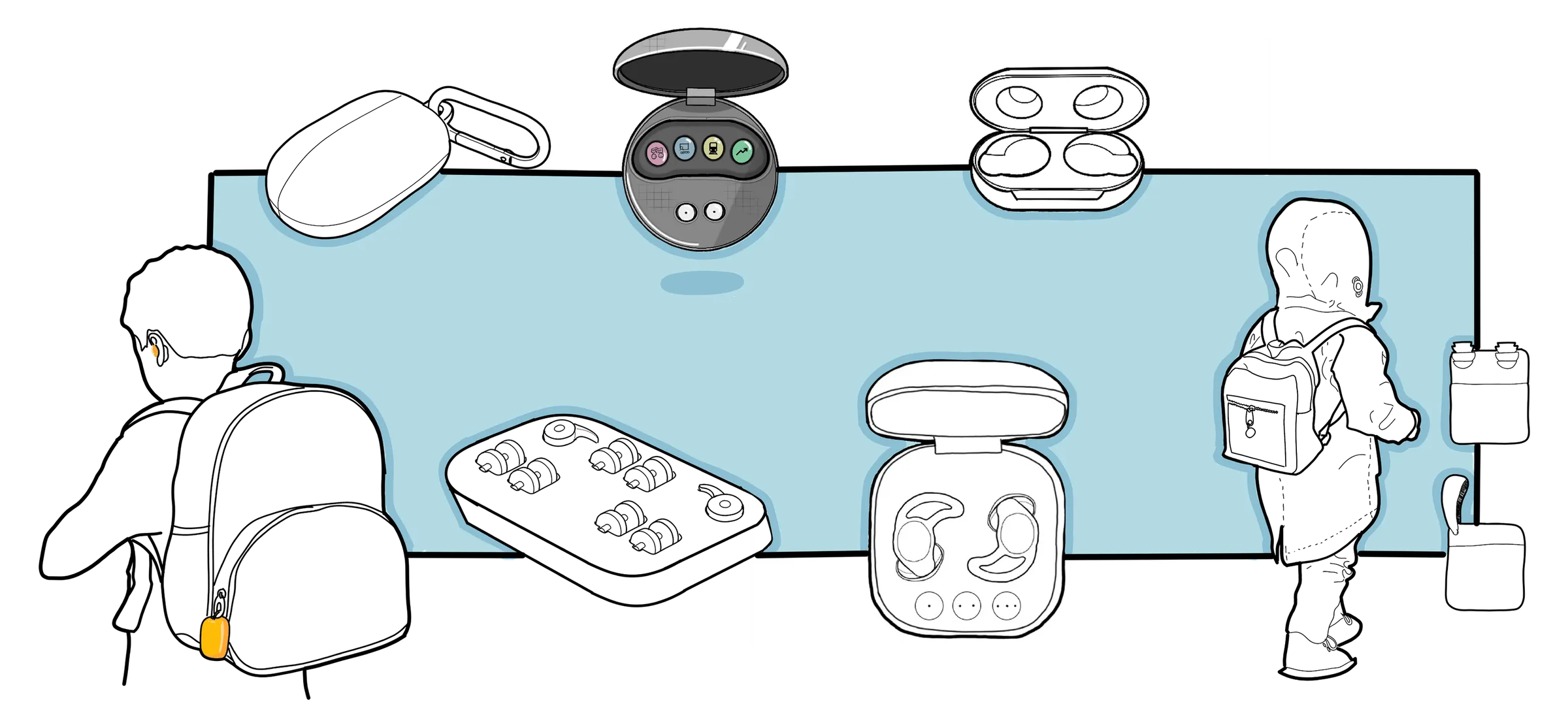
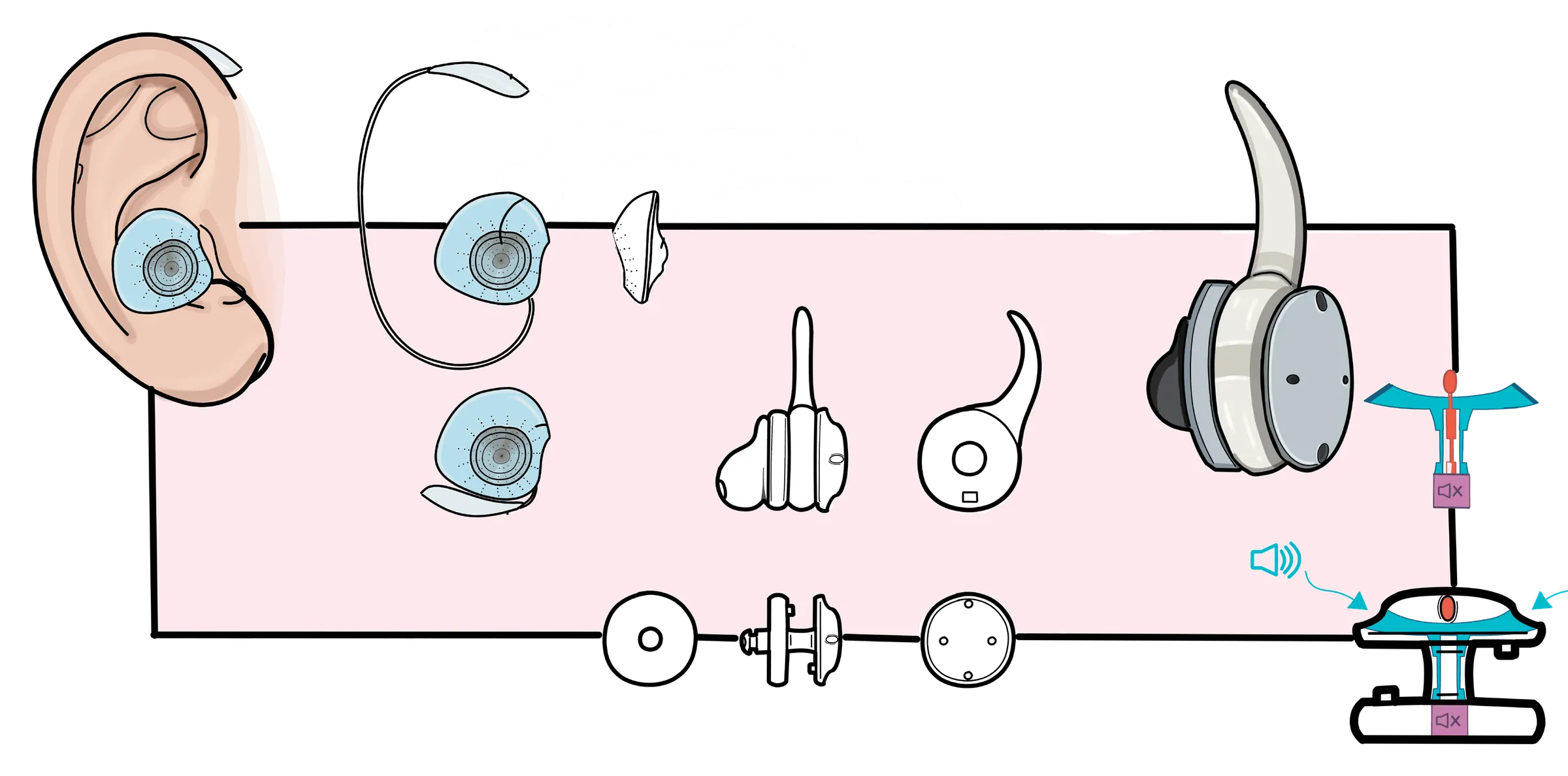
Our concepts for the earbud and its case:
Interchangeable filters: noise filters that can be changed into the earbud, attenuating different sounds according to their environment.
Icons on the case: one of our more interesting concepts, which looks to use icons to help the user know which ear tips to use in order to not suffer a sensory overload.
A clip for the school bag: an idea we had for the case is to ensure that it cannot be lost by the user. This clip allows the user to attach it to their school bag.
Carrying the inserts: these designs look at how the user can carry their different frequency prevention inserts.
A stylish accessory (by a teammate): this concept further develops how the case could be used to help destigmatise the use of our product.
Concepts for the earbud and its case.The case as a stylish accessory (right) is a teammate’s concept.
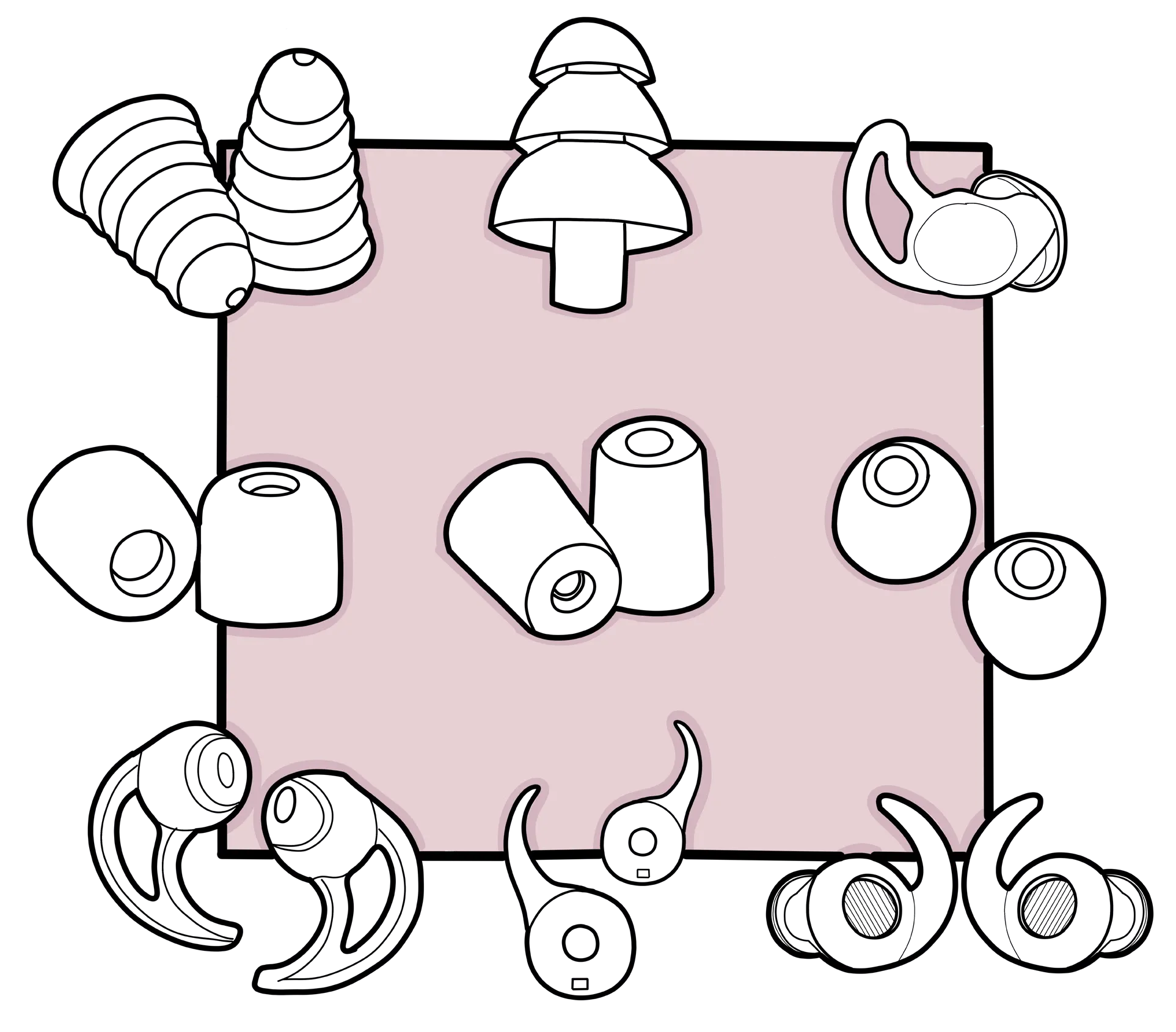
We designed numerous ear tips of different shapes and sizes, taking inspiration from many current products. Our aim is to send samples of these ear tips to our user group in order to determine which gains the best response.
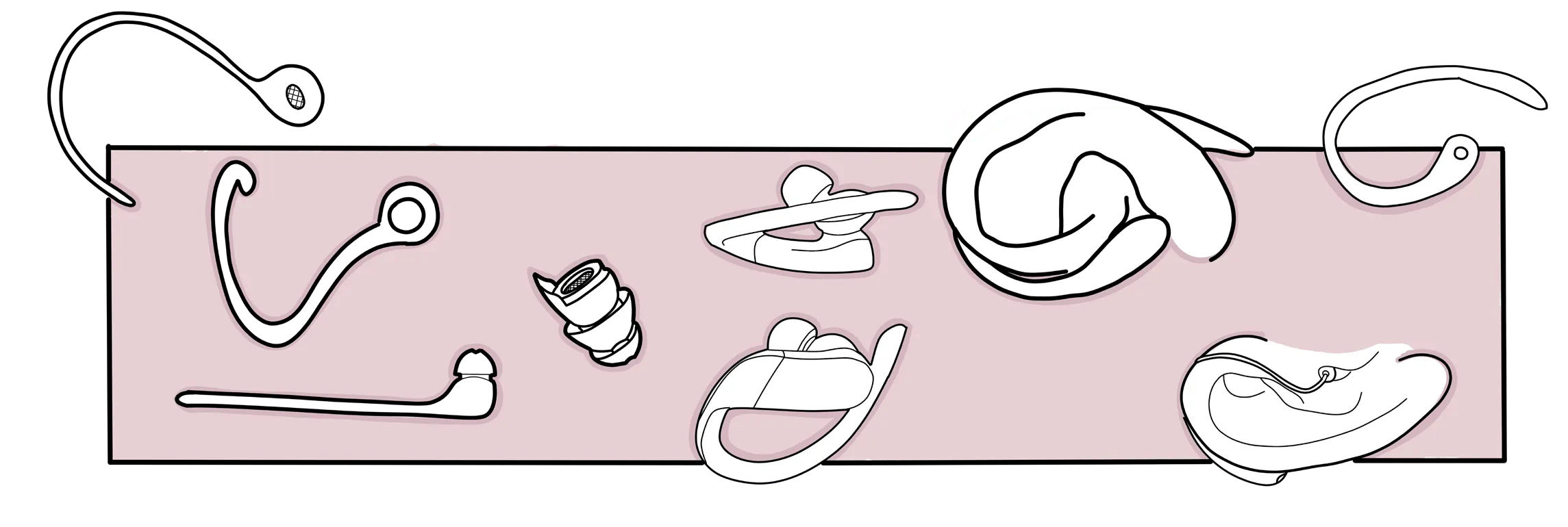
We also looked at current hearing aid designs, as we figured this could be an interesting route to take. We tried to design them by taking inspiration from sports earphones in an attempt to destigmatise them; however, we still felt as though these were not discreet enough.
One design took heavy inspiration from a hearing aid; the main aim was to find an alternative method to hold it to the ear. Another focuses on directing the sound to the ear through the use of various resonators.
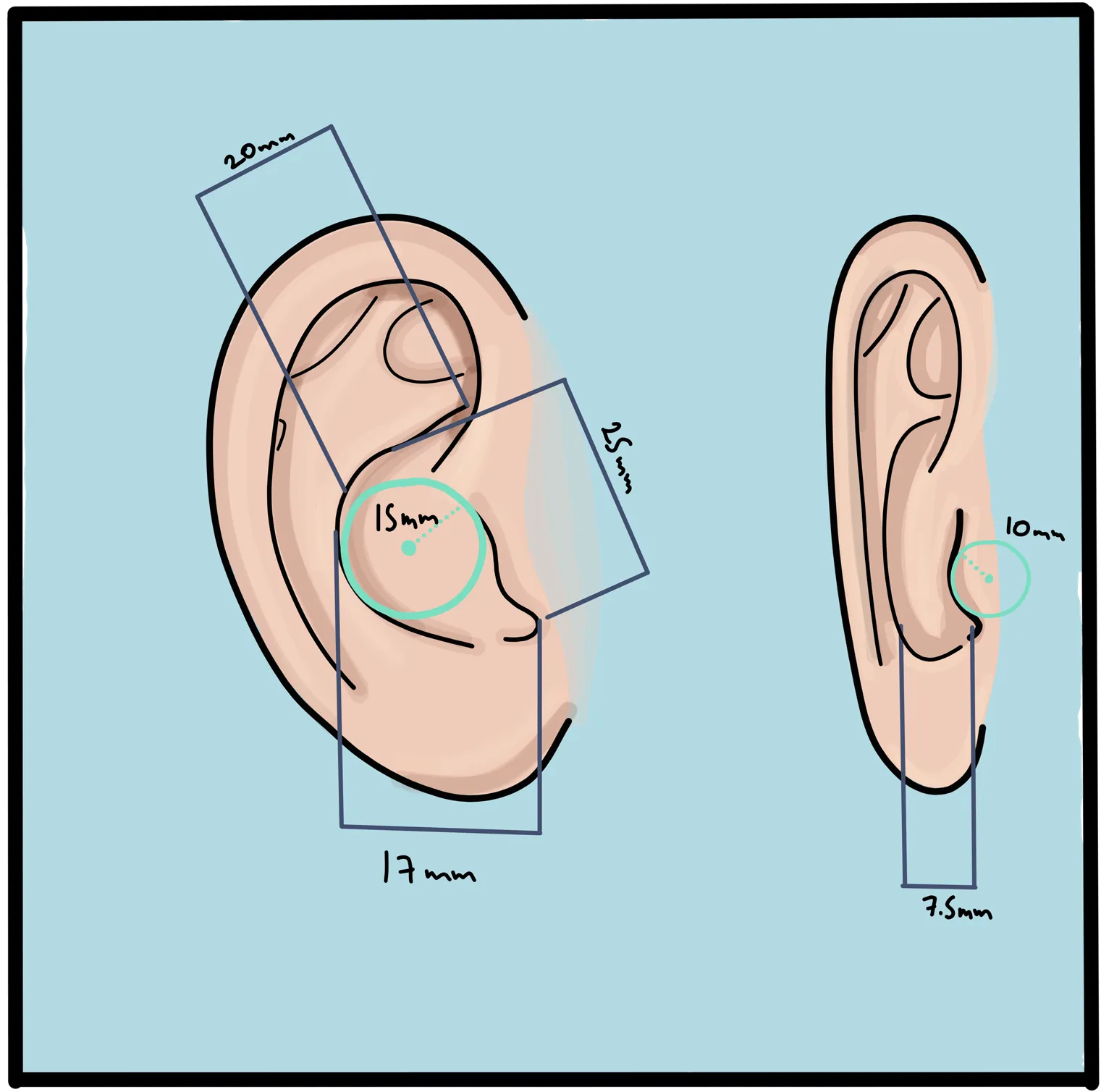
We measured two 8-year-olds’ ear dimensions along with two 14-year-olds’ ear dimensions. We then took the average dimensions from these to try and gain a rough estimate of the sizing of our final design.
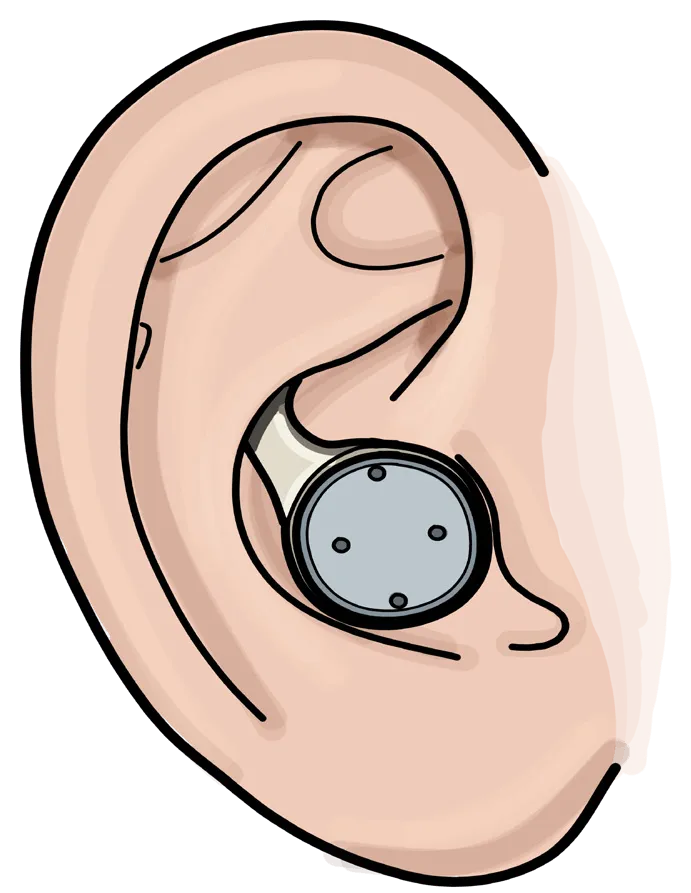
We aim to have these sizes be fluid, through different ear tips. A sketch was used in order to scale the product in the ear. This helped us to visualise how the design may look before the prototyping phase.
This is a discreet in-ear design that causes fewer auditory sensory issues through the use of acoustic filters. These filters are currently being outsourced in order to ensure that the production and quality of this product meet demands.
The product will come with different acoustic filters that can be interchanged, in order to allow the user to customise their use of the product, to ensure they have minimal effects to their hypersensitivity.
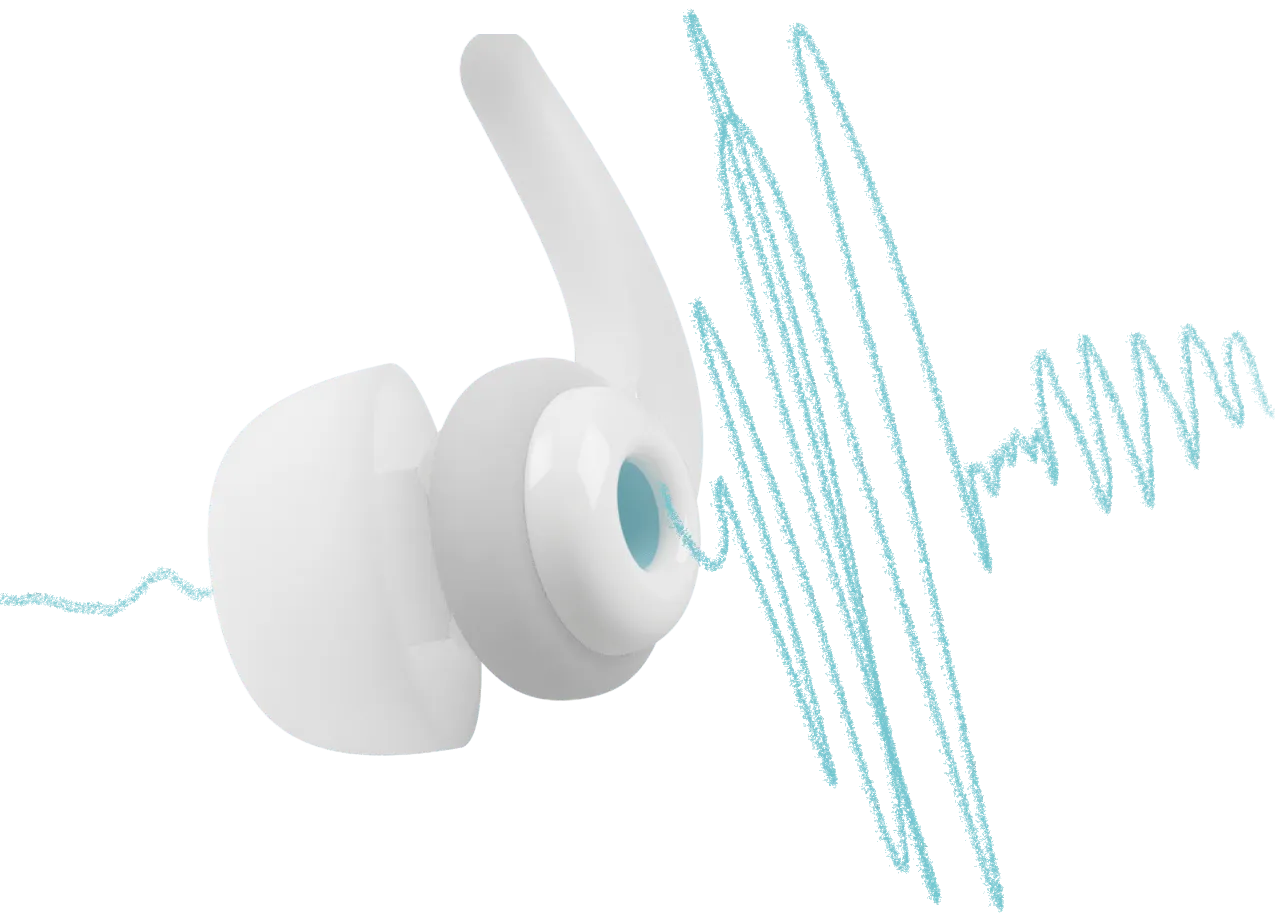
Phonics attenuates sound using a nonlinear acoustic filter. These filters are made from a diaphragmatic mesh, and the density of this mesh determines what frequencies the filter can attenuate.
The earbud creates a tight seal in the user’s ear, meaning sound is forced to pass through the passage in the product to enter the ear. As a result, all sound that enters the child’s ear also passes through the filter.
The passage in Phonics has a resonance of 2,500 Hz, similar to that of the ear, meaning there is no distortion to the sound.
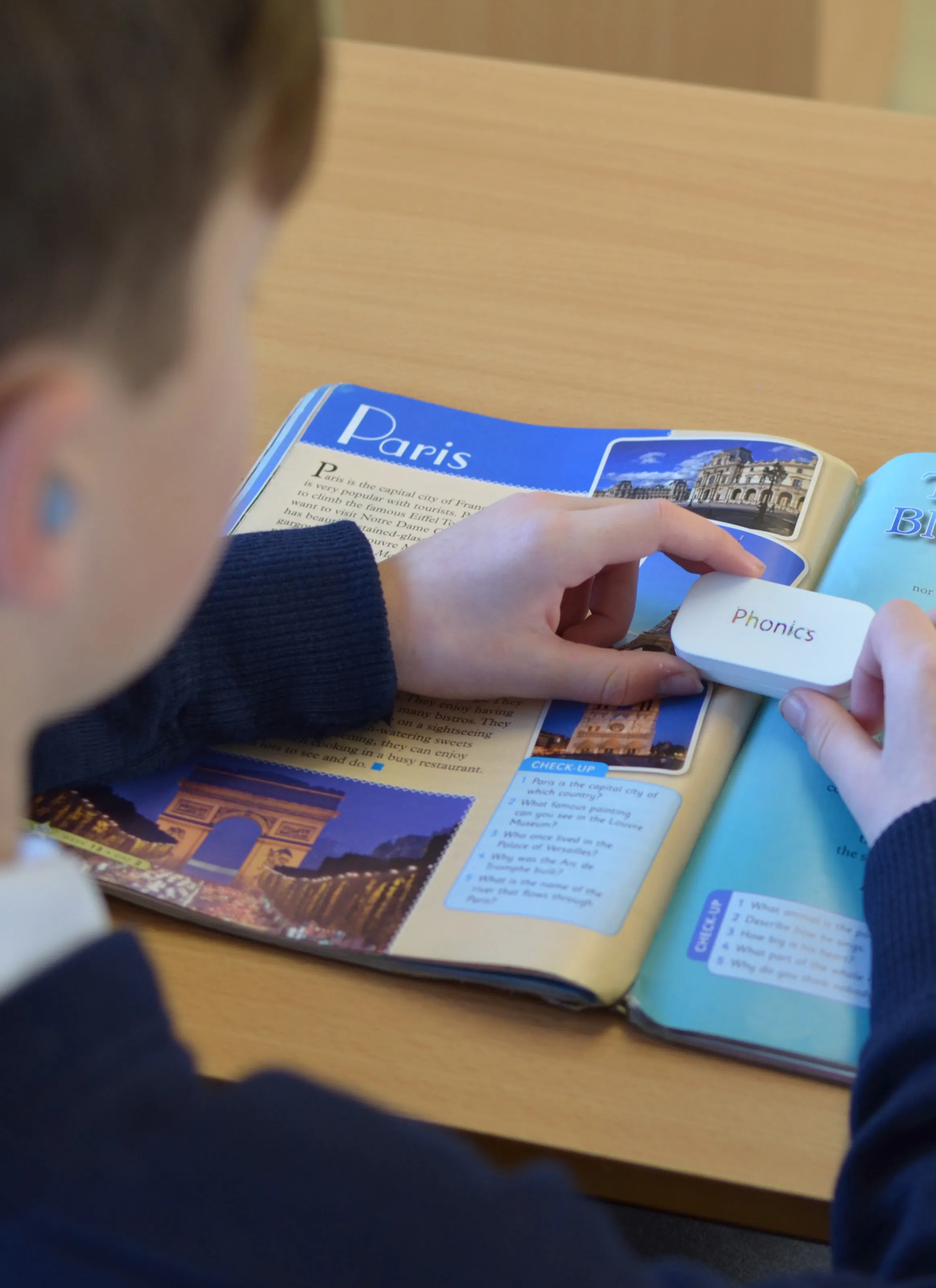
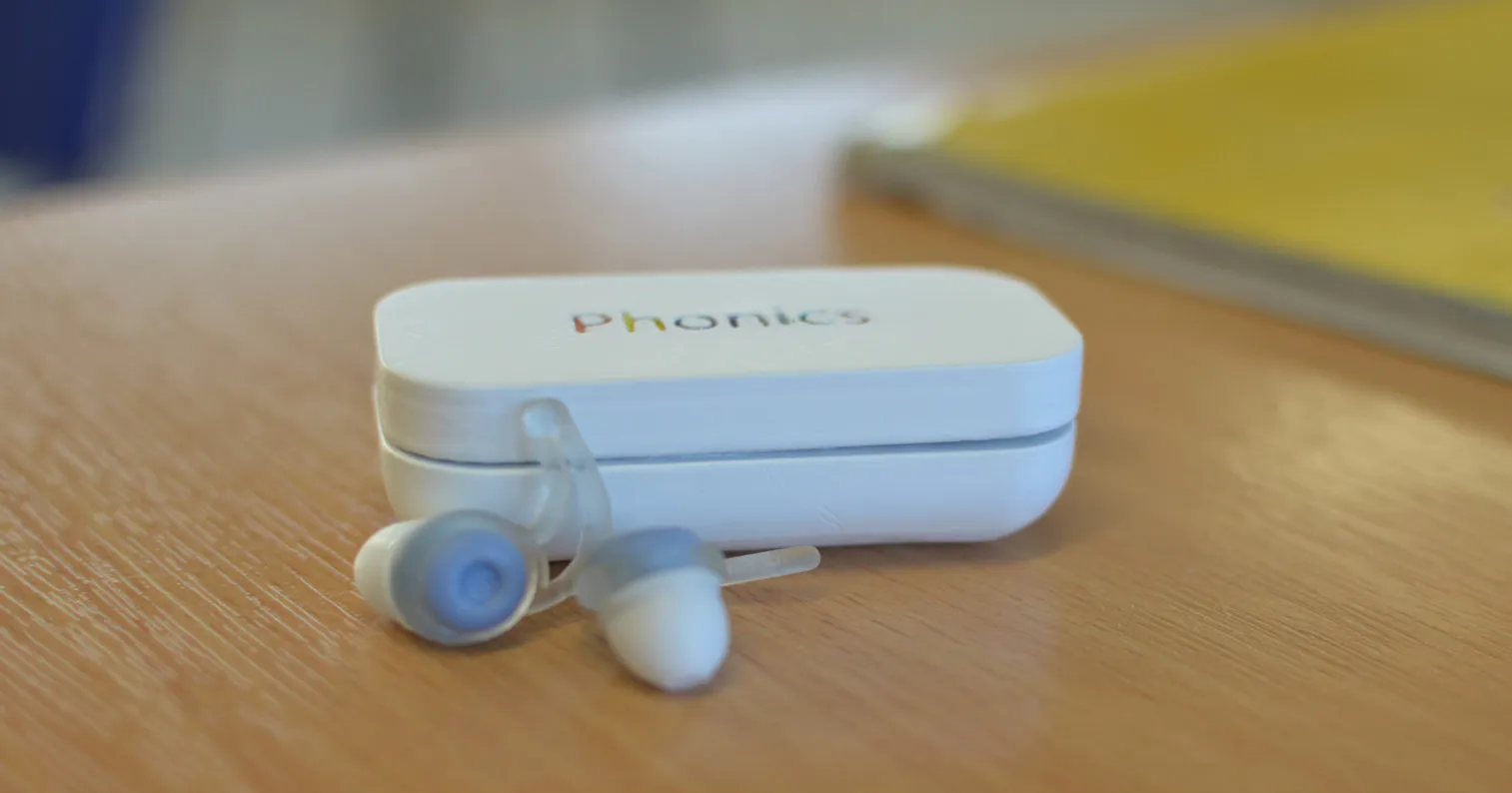
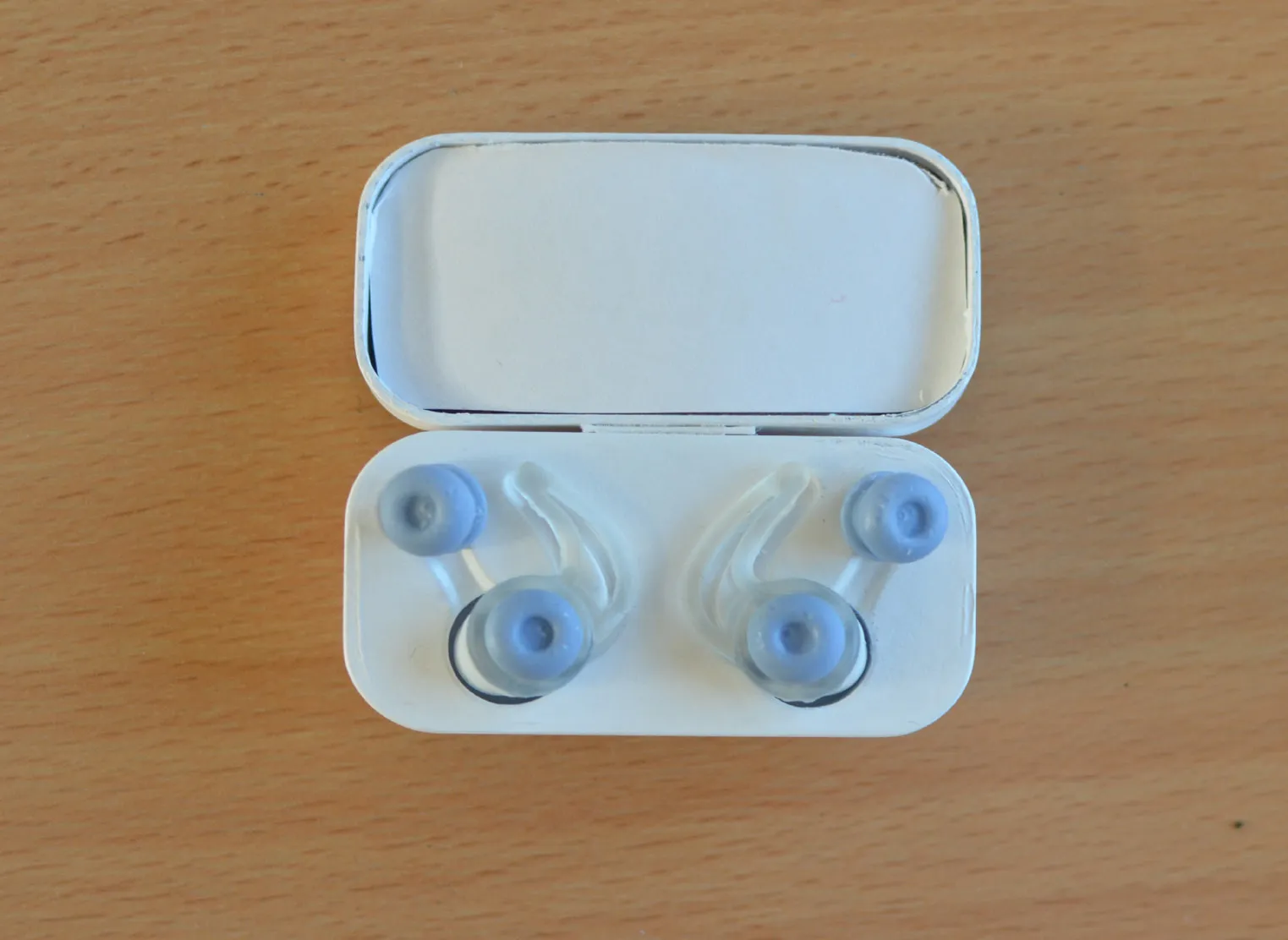
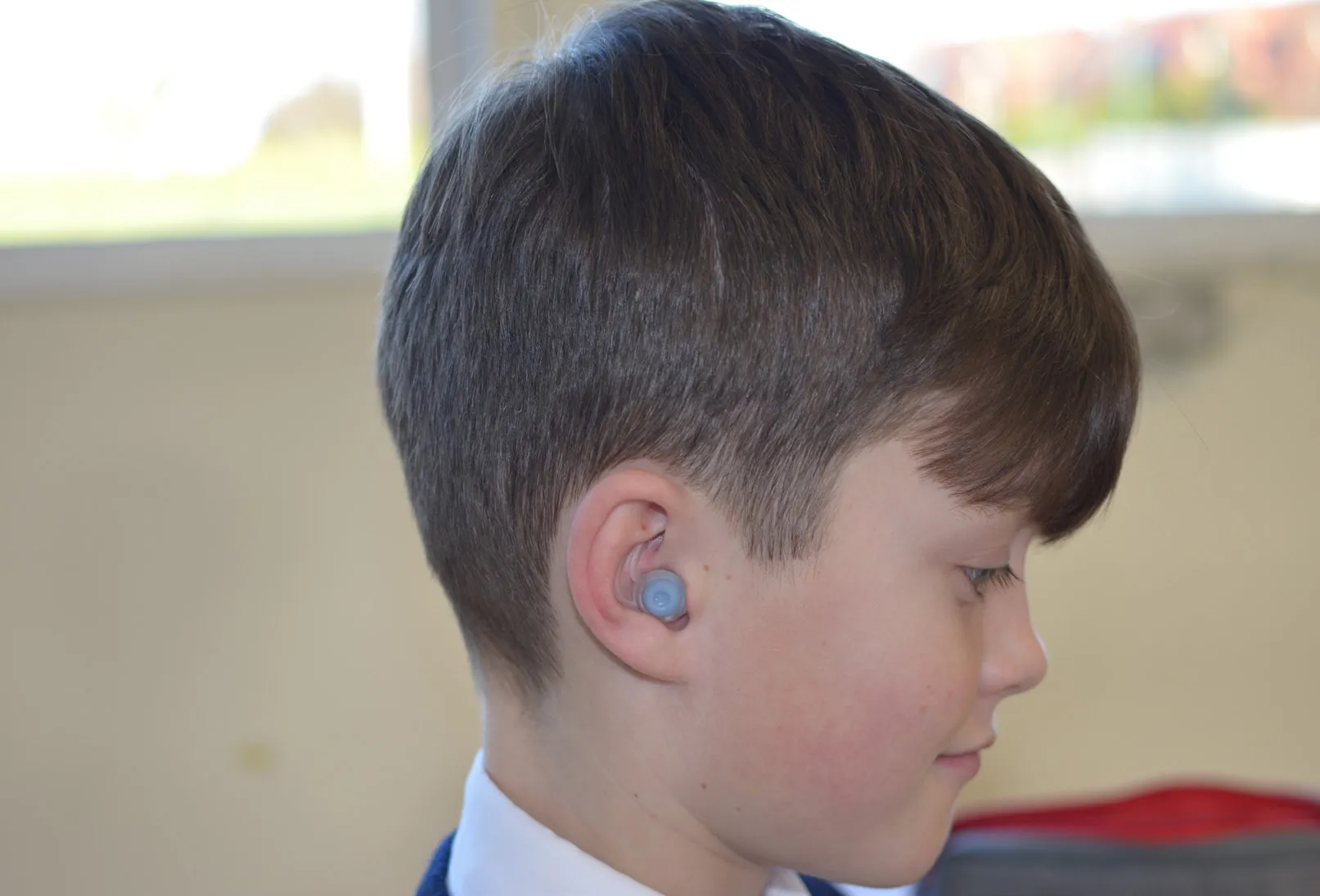
The final prototype was 3D printed. This consisted of a case, 4 filter housings and 2 silicone ear hooks. In order to reduce costs, pre-owned ear tips of different sizes were also used. The printed prototypes were hand-finished and painted.
Although it was not a functioning prototype, it allowed the user to interact with the product, and confirmed the correct sizing of the product from the human factors and ergonomics studies.
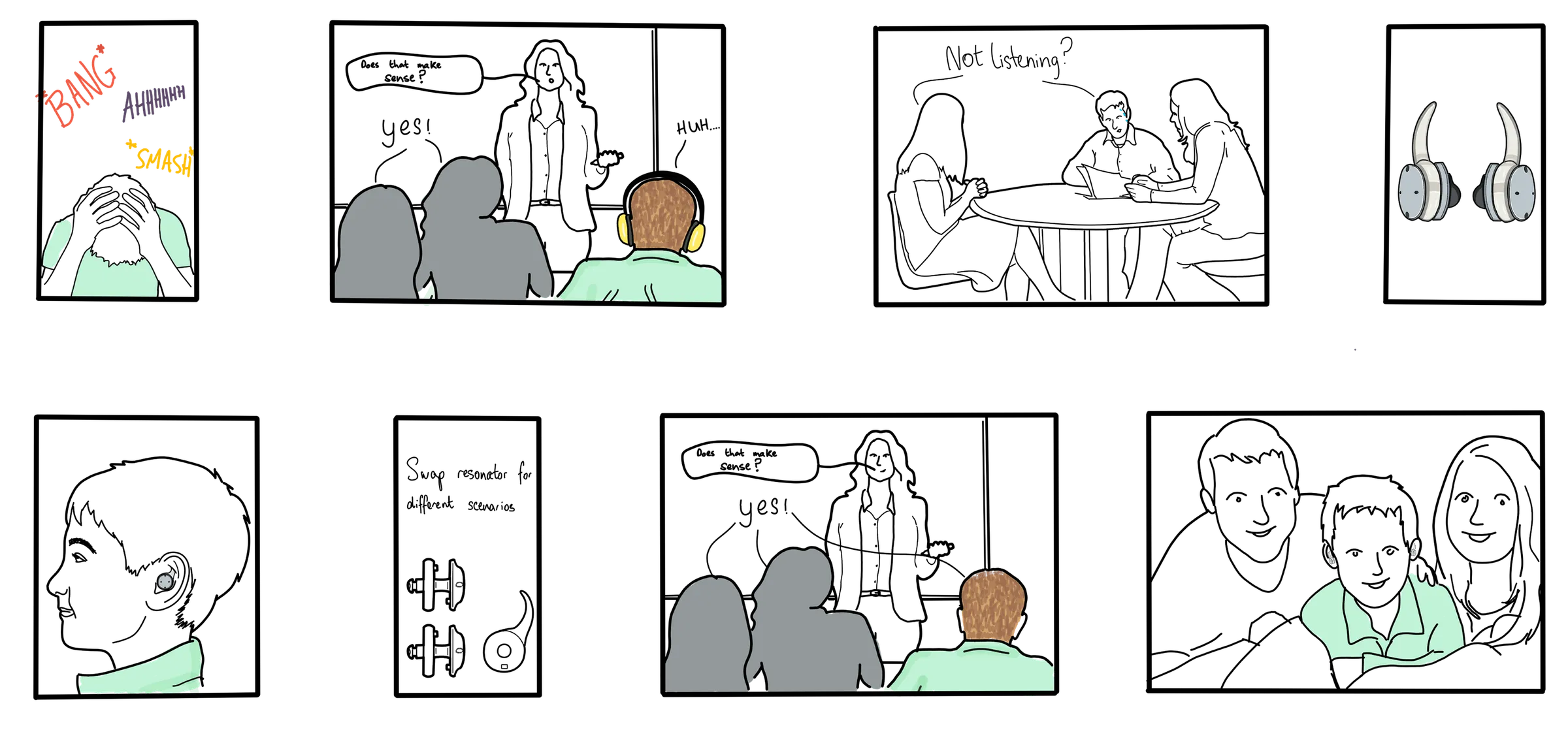
With no aid, Simon suffers from a sensory overload.
Simon tries ear muffs, but struggles to hear the teacher or his friends.
His parents are being told over and over that he is not listening, and it takes its toll.
Introducing Phonics.
Simon no longer has to wear large headphones during class time.
He can change the attachments depending on how sensitive he feels.
Now he can listen in class without a problem.
Simon’s relationship with his parents has improved greatly.
What’s next?
More prototypes. If there were more time to work on this project, further prototyping would be explored, potentially testing other shapes and designs that may suit the user more accurately.
A working prototype. The prototype wasn’t a working one, and the acoustic filters were being outsourced. Working filters would show how well Phonics softens triggering sounds while keeping the teacher’s voice clear.
More test users. One test user tried the prototype. Testing with more children, in class and for longer, would show whether it stays comfortable and discreet over longer periods.